
Texas’s Other Climate Problem
The damage and response to the Texas disaster of deadly cold weather combined with a major electrical failure and burst water pipes will be debated for a long time.
Two aspects are front and center in the discussion:
First, the need to plan for greater resiliency in the face of even more extreme weather, both record-breaking heat – as well as snow storms – part of the destabilizing climate, paradoxically a symptom of a warming planet.
Second, what are the implications and lessons for their use of fossil fuels and their power grid, both for reliability and consideration of not adding to the global warming / greenhouse gas problem, often referred to as sustainability?
Both questions are critical in a world that keeps warming, with lessons far beyond Texas. They are often bundled as “the climate problem.” They are related, but very distinct.
Those two issues are understandably the topic of the day, but Texans should not forget about the third related, but distinct issue: rising sea level, which requires adaptation.
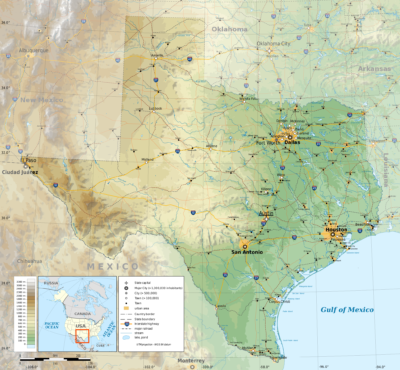
Texas has the seventh longest coastline of any state in the U.S. It’s either 367 miles (591 km) measured most simply along the Gulf of Mexico, or nearly ten times longer, if you count all the inshore estuaries, port areas, and ship channels. (To be accurate, the full coastline is 3,351 miles according to the World Atlas.)
 Texas has been well aware of the problem of rising seas, even before Hurricane Harvey devastated the state, making landfall on August 25, 2017, near Corpus Christi, in Port Aransas. I will never forget the timing and location. That was just two weeks after I gave the opening keynote for a small conference, “Resilient Texas: Planning for Sea Level Rise” as shown on this event poster.
I publicly applauded them for thinking about future sea level rise, but reminded them that extreme coastal storms could add to sea level rise for more severe short-duration flood events. The record-breaking Hurricane Harvey spun up very quickly in the Gulf of Mexico making landfall at…Port Aransas. Truth can be stranger than fiction. (Bill: Should I mention this story being in the new book?)
The Texas tragedy last month will hopefully spur some fresh thinking about the climate problem, both in that state where energy politics are dominant, and with lessons elsewhere. As the problem is addressed, we would be smart to recognize “the problem” as those three very distinct issues, sustainability, resiliency, and adaptation.
From the News This Week…Gigantic Antarctic Iceberg
It was widely reported last week that iceberg “A74” roughly twenty times the size of Manhattan broke off from Antarctica. It is noteworthy and also recalls the far larger A68 that broke off three years ago. It’s a good opportunity to clarify some of the common confusion about icebergs, ice shelves, and Antarctica.
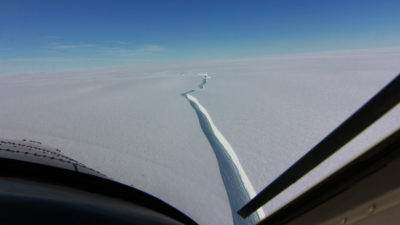
Iceberg A74 breaking off from Antarctica late February 2021
- Antarctica has been covered by ice for approximately thirty million years. For all of human civilization, roughly 6-8 thousand years, the ice sheet has been fairly stable in size.
- Antarctica holds about 186 feet of global sea level (56 meters) if it all were to melt. Greenland’s ice sheet is only about one seventh as large, but it is melting much more rapidly that Antarctica.
- The vast majority of ice on Antarctica is the ice sheet covering most of the continent. Embedded within the ice sheet are hundreds of glaciers, the slowly moving rivers of ice that drain towards the sea. As they reach the sea, large pieces break off, or calve, creating a new iceberg, a floating block of ice.
- Ice shelves are large flat areas of ice that fill various bays. They are floating ice. They can be a thousand feet thick, but like an iceberg only appear about ten percent above the surface.
- Because ice shelves and icebergs are floating, they have already displaced seawater and have had their effect on sea level. As they melt or break into smaller pieces, they have no further effect on global sea level.
- However, as the gigantic ice shelves crack and break up, they are like a cork being removed from a bottle. As they disintegrate, the glaciers on land can flow into the sea, which does add to global sea level, at least incrementally.
We are seeing more and more of these giant cracks and disintegration of the ice shelves. While no one event can be said to be caused by global warming, it is safe to say that the warming world is causing the increased melting of the ice on Antarctica and Greenland. For a report on the new giant iceberg,
https://www.cbsnews.com/news/iceberg-anartica-breaks-larger-than-new-york-city/