
10 feet of Sea Level Rise in 10 Years?
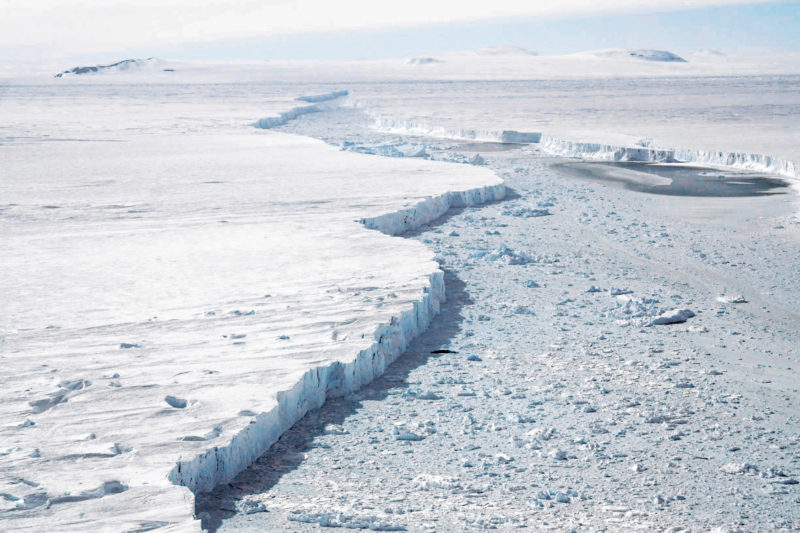
Huge floating ice shelf in foreground. In the distance Thwaites Glacier on top of mountainous West Antarctica. [NASA image]
The colossal Thwaites Glacier in Antarctica – often referred to as the Doomsday Glacier – was the subject of an extraordinary press briefing at the recent American Geophysical Union (AGU) meeting. Some of the leading experts participated live from Antarctica. Their latest research yielded two ominous findings about the enormous ice shelf. As shown above, the shelf has a rather flat upper surface and is floating. It’s about a thousand feet thick (~300 meters), but with just ten percent above the water line. Like icebergs, or ice cubes floating in a glass, floating ice does not affect water level as it melts. In the distant background, Thwaites Glacier can be seen as it slowly flows off mountainous West Antarctica into the sea. It’s that ice on land that will raise sea level as it enters the water, the same as the water level increasing from a new iceberg calving off a glacier, or adding an ice cube to a glass of liquid.
In simple terms, the two new key findings announced this month were:
- Due to greatly increased melting of the gigantic ice shelf from below the surface by relatively warm ocean currents, it could detach from its “grounding” on a submerged mountain in less than 10 years.
- The ice shelf is fracturing like the early stages of a car windshield hit by a rock, possibly causing spontaneous disintegration in less than five years.
Together these findings should sound the alarm. To better visualize this, see the illustrations below. The scientists pointed out that just Thwaites Glacier by itself holds enough ice to raise global sea level approximately two feet (50 cm). But that’s just one glacier. Five other adjacent glaciers and the larger unstable area of West Antarctica make the problem five times greater, with a risk of global average sea level rising roughly ten feet, just from those sources.
The glaciologists did not say that the glaciers would quickly slide into the sea following either or both of the specific threats cited above.
The giant ice shelf acts like a stopper in a bottle, holding the giant glaciers up on the Antarctic landmass. If the ice shelf becomes detached or disintegrates, the glaciers are able to slide into the sea unobstructed. That new ice entering the water, would raise global sea level, again, just as adding ice cubes raises the level of liquid in a glass.
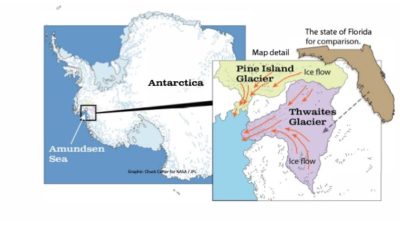
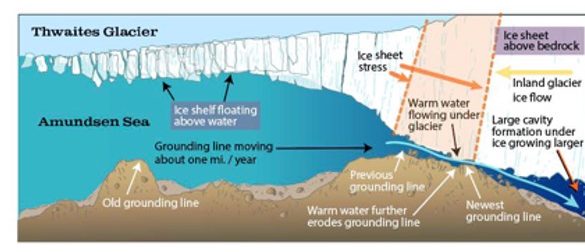
Graphics: Chuck Carter for NASA/JPL
To be clear, 10 feet (~3 meters) of global sea level rise would displace hundreds of millions of people in some 140 coastal nations. But even if this ice shelf disintegrates as the second finding foresees, the giant glaciers up on Antarctica are not going to rapidly slide into the sea in just a few years. For those huge glaciers to fully slide into the sea would almost certainly take decades, or even centuries. Even if it took a hundred years however, we need to start planning now. With sea level having been stable for some six thousand years, we have acted as if the coastline was a fixed boundary. Geologic history makes clear that both sea level and shoreline can move greatly.
From architecture to engineering and from finance to law, a wide range of professions need to start considering the enormous implications of unstoppable and somewhat unpredictable rising sea level. Trillions of dollars of assets will go underwater, financially and literally. The sooner we look “over the horizon” to see the virtual tsunami heading for us the better. This is the work of the Rising Seas Institute, our nonprofit. http://www.risingseasinstitute.org [Contributions to support our work would be greatly appreciated.]