
The Sea is Rising. Get Over It.
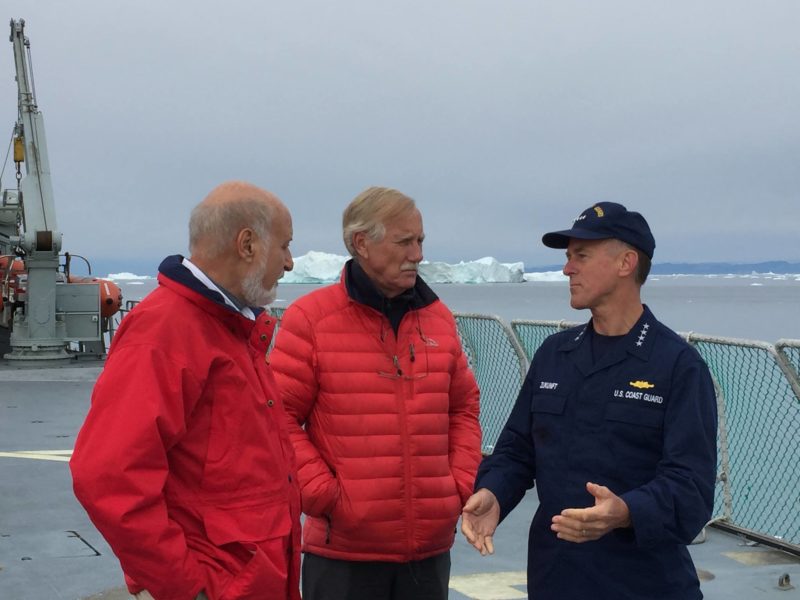
John Englander, Senator Angus King, and USCG Admiral Paul Zukunft in Greenland (Photo: Patrick Kelley/USCG)
We just don’t want the sea to rise, permanently changing coastlines, submerging most coastal communities, putting property values underwater. I get it. Of course, we also don’t want grandparents and parents to die. Nor children. Yet we accept those realities as part of the “circle of life” looking ahead to new birth and renewal. Regarding our changing planet, if we are going to really invest in the future and adapt to the unstoppable force of the rising ocean, we need to accept, encourage, and share the new reality and awareness of rising sea level. Bluntly stated, The sea is rising; get over it.
Let’s review the facts, understand the “stages of grief” and find a positive way to look at the situation. (I’ll tie this in with the photo above in a moment.)
- Global sea level changes with average global temperature (climate) as the great polar ice sheets expand and contract, normally over tens of thousands of years.
- The geologic record is clear that sea level moves up and down about four hundred feet (~120 meters) regularly, roughly every hundred thousand years, a pattern we think of as the “ice ages” which have occurred for more than two and a half million years.
- We have now broken out of that pattern due to changing the gases in the atmosphere. We are entering a super warming phase, when nature would have been putting us into the next cooling cycle. Carbon dioxide (CO2) acts like a thermostat changing the heat level or balance. My chart of the last 400,000 years in the blog post a few months ago makes the relationship of CO2, global temperature and sea level simple and clear. CO2, now at 415 ppm (parts per million), almost fifty percent above the normal upper limit of 280ppm, is rocketing upwards.
- As I wrote in the last two blog posts, we should try to use technology to replace fossil fuels and even to remove CO2 from the atmosphere. Re-joining the Paris Climate Agreement is a good thing and commits us to a good goal. But as I pointed out, they are setting a goal to stop the increase of carbon dioxide by 2050, thirty years from now as an attempt to stop the warming to another degree Celsius, almost two degrees Fahrenheit. If we can achieve that, the warming would stop in a few more decades. But even when the warming stops, the ice will keep melting for decades, raising global sea level.
- Even if we could magically stop the use of all fossil fuels “today” the extra heat that is already stored in the sea, is going to cause a lot more of the polar ice caps to melt, raising global sea level more than ten feet (~ 3 meters), very possibly in the next hundred years, and more thereafter.
In fact to put a final spike in the illusory dream of stopping global sea level rise and keeping the coastline where it’s been for some six thousand years, look at that chart again. At the last natural warm spot in the cycle, 122,000 years ago, sea level reached 25 feet (~8 meters) above present sea level. That was a natural high-water mark, without the effect of human population and technology causing extraordinary warming. We might have reached that water level even without the global warming caused by altering the composition of the atmosphere. But we did not understand that until about a century ago. Thanks to good science, our understanding of geo-physics has dramatically improved, similar to the way our understanding of the biologic processes has catapulted forward in little more than a half century.
Our beliefs and emotions are not so quick to change. We cling to wishful thinking. It’s part of being human. Experts point to the “stages of grief” often framed as the Kübler–Ross Five Stages of Grief:
- Denial
- Anger
- Bargaining
- Depression
- Acceptance
From my decade of experience explaining the facts of rising sea level most are at stuck at the first rung of the ladder, essentially denying that the sea is going to rise. Of the small number who are beyond denial, are somewhere between the second and fourth stages. Hardly anyone is at acceptance. While I can understand that because it defies the reality that we wish for, it is no more realistic than preventing death or any of the other misfortunes that we would prefer not to have happen. This is not the place to explore philosophies and belief systems, but the French perspective seems apropos: C’est la vie. It is the life.
For those interested, these are themes I explore and explain in my new book, Moving to Higher Ground: Rising Sea Level and the Path Forward which will be published two months from now, April 6, 2021 to be specific. In addition to updating the science from my previous book (High Tide on Main Street: Rising Sea Level and the Coming Coastal Crisis) the new book focuses on the practical, psychological, and political blockages to progress. In the next few weeks, I will try to give a little insight into the book, which covers everything from designing for the future, to engineering with a margin of safety, and how insurance and public policy often are counter productive. It points to a new future vision, looking at the “glass half full” rather than the negative, half empty. While there are many obvious problems with unstoppable sea level rise, I make the case that we need to look to the future. While trillions of dollars of assets will be destroyed by the rising sea, a greater amount will have to be created. I make the case that rising sea level will be the greatest economic engine this century.
Which brings me to the photo at the top. That’s US Coast Guard Commandant, Admiral Paul Zukunft, talking to me and Senator Angus King a few years ago on our fact finding trip to Greenland. Admiral Zukunft, now retired, had invited me to make the case about rising sea level to all the flag officers (largely, the admirals) of the Coast Guard at HQ in Washington D.C. Absorbing the strategic implications of my message, the Commandant decided to see the problem for himself and invited Senator King, in his capacity as leader of a Congressional committee dealing with the Arctic. Using a military frame, the Admiral said something to the effect, that there are situations that we can avoid and try to distance ourselves, but there are situations where the only smart course is to be proactive, to tackle a threat head-on. With rising sea level, Admiral Zukunft said we needed to “lean into it”, meaning we needed to face the challenge with planning and purpose.
While this may be a little early to promote my new book, both of these leaders and all of these concepts are in Moving to Higher Ground. It will be available in all formats, hard cover, soft cover, e-book and audio book and in fact can now be pre-ordered from any of the usual online sources and from retail bookstores. I point this out, because this is the time when bookstores and libraries are ordering the book. If you are interested in this topic, this would be a great time to pre-order, even to ask your library to get a copy from their usual distributor. If the bookstores, libraries, and online sources see early orders, it can help to bring attention, “create a buzz” and possibly reach “best seller” status. Besides my interest in selling books, this is a powerful way to get attention to the message. In future weeks I will share some excerpts here.
Greenland Expeditions: On a related note to the scene above in Greenland, I will be organizing two trips to Greenland for late August, similar to the program we did with the Admiral and Senator. These expeditions are limited to eight people per trip. These are exclusive and frankly rather expensive. But for those wanting to witness first hand the dramatic melting that is ultimately the cause of sea level rise, there is no better experience. To find out more, send an email to: greenland2021@johnenglander.net